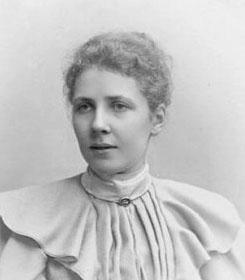
Elsa Beskow (1874–1953) was a Swedish children’s writer and illustrator of children’s books.
She studied art history at the Faculty of Arts of the University College of Arts, Crafts and Design. After the publication of her book Putte’s Adventures in the Blueberry Forest (Puttes äventyr i Blåbärsskogen) in 1901 — which she also illustrated herself — Beskow gained wide recognition. Already two years later, the book was published in German and Polish; at the same time, the first Russian edition appeared. Published in Saint Petersburg by Devrien under the title The Blueberry Old Man, it listed Beskow only as the illustrator, while the author was credited as “Uncle Yak.”
Elsa Beskow also illustrated works by other authors, including Alice Tegnér, Amalia Falsted, and Jeanne Oterdahl.
The turn of the century was a crucial period in the history of Swedish children’s literature. In the nineteenth century, Scandinavian writers discovered the richness of national folklore, which encouraged the emergence of the literary fairy tale. Pedagogical views were also gradually changing. Children were not only noticed but were taken seriously, and people began to think about how to make education and upbringing resonate with the spirit of the time. Children’s reading played a major role in these changes. Many almanacs for children appeared, attracting writers and artists to work for a young audience.
It was precisely at such a time that Elsa Beskow entered literature. Her work was shaped by the ideas of national romanticism — an artistic movement of the late nineteenth and early twentieth centuries to which many Scandinavian artists belonged, including Carl Larsson, who left behind numerous depictions of family life and rural scenes, as well as John Bauer, the great fairy-tale artist who revealed to readers the world of gnomes and elves.
In her books, Beskow combines reality with imagination and the world of fairy tales: children encounter elves and goblins, animals can speak. The central theme of her books is the relationship between children and adults. The plots of Elsa Beskow’s stories are marked by gentle sentimentality. This is a cozy, almost conflict-free fairy-tale world that largely reflects ideas about childhood as they existed in the early twentieth century. Conflicts in her stories are conditional; there are no tragedies here. The characters — even when they are fairy-tale creatures — are ‘rooted’ in nature. They are usually ‘small’: little elves, little gnomes, little animals. The stories are conveyed not only through words but also through images. In fact, the illustrations constitute the main value of Beskow’s books. It is precisely in them that the innovation of the Swedish writer and artist is expressed.
The Swedish literary historian Boel Westin believes that Beskow was the first to depict the world as if seen through the eyes of a small fantastic creature. When looking at her characters, it is immediately clear that they belong to the world of fairy tales. All her heroes are usually busy with their fairy-tale occupations. The surrounding world is full of unexpected details and magical nuances. At the same time, as B. Westin notes, Beskow’s depiction of nature is ‘absolutely accurate from a botanical point of view.’
Elsa Beskow is also credited with creating an original layout for the picture book: an album format; on one side, a full-page color illustration; on the other, text framed by a thin black border accompanied by several small graphic drawings.
Website | elsabeskow.se
Amazon | Elsa Beskow
Books
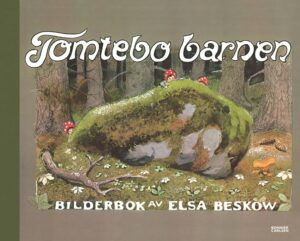
Tomtebobarnen
The first “golden age of children’s literature” in Sweden came at the beginning of the 20th century, and it is inseparable from the names of Selma Lagerlöf, Anna Wahlenberg, Helena Nyblom, and of course Elsa Beskow. Beskow not only wrote fairy tales for children, but was also an outstanding children’s […]