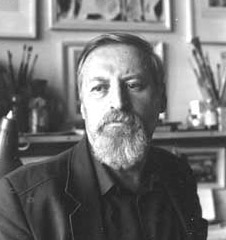
Anatoly Zinovyevich Itkin (born 1931) is a Russian artist and book illustrator.
He graduated in 1956 from the Graphic Arts Department of the Surikov Art Institute in Moscow and also studied in the book illustration workshop of Professor B. A. Dekhterev. Itkin has been illustrating children’s books since 1953 and has illustrated more than 200 works of Russian and world classical literature. He has also worked extensively in printmaking and paints watercolors from life.
In the 1960s and 1970s, Itkin devoted much of his work to Pushkin-related themes. He created a series of color prints based on Yuri Tynyanov’s novel Pushkin and a series of lithographs titled Poets of Pushkin’s Circle. During the same period, he produced a cycle of drawings reflecting memories of his childhood in the 1930s, known as Childhood in Ostankino.
Anatoly Itkin has participated in exhibitions in Russia and abroad. Since 1998, he has held the title of Honored Artist of Russia. His works are held in numerous museums and collections, including the A. S. Pushkin Museum in Moscow, the Central Pushkin Museum in Saint Petersburg, the Tver Regional Museum, the A. Tolstoy Literary Museum in Samara, the S. T. Aksakov Museum in Abramtsevo, as well as in private collections in Russia and other countries.
“I started drawing in very early childhood. My grandfather was a typesetter, and he used to bring home lots of paper scraps from the print shop. We even covered the dark wooden ceiling with them to make the room brighter. In short, there was so much paper in the house that I naturally took to drawing. And I’ve been drawing ever since.”
“I don’t like the new trend where a book cover is made not by the artist, but by someone else using computer tools. I believe the cover should be created by the same hand as the illustrations, and it should reflect the artist’s own idea.”
“When you read a text, an image always appears. Where does it come from? It’s hard to say. A good artist has a sense of generalization and can perceive people as types. So when you read a book, a specific human type immediately forms in your mind. If you stay true to that first impression when depicting a character, the result is usually good. Sometimes you drift away from it, and then the result is worse.”
“When flat chests and long legs become fashionable, what should people with fuller figures and short legs do? Die? Leave the stage? Stop reproducing? When dull socialist realism was replaced by expressionism, strangeness, imbalance, and deviation from the norm became highly valued. You go to exhibitions and see one madman after another. But what should calm, balanced, normal people do in such circumstances? Mimic madness? Pretend? Imitate expression? I’ve asked myself these questions too. But I couldn’t and didn’t want to adapt to the latest trends. I chose to remain who I was. Fortunately, an illustrator can choose literary texts that suit their style. My artistic language turned out to be in demand. My realism avoids excessive grotesque and emotional exaggeration. For me, truthfulness and credibility are virtues. If a drawing has those qualities, and also expressiveness, I consider it successful. Since my student years, I’ve held to the principle that one should not focus deliberately on self-expression. It’s better to focus on the needs of what you are depicting. Self-expression will take care of itself in the process.”
Nika Golts on Anatoly Itkin
“Anatoly Zinovyevich has an extraordinary ability to immerse himself in the specific author and the specific book he is illustrating at the moment. When it’s Jules Verne, it is unmistakably Jules Verne. Once, he decided to redo an illustration because he didn’t like the figure in the foreground. In the background there was a ship approaching, very small. I said, ‘You could just wash out the figure in front and draw a new one.’ He replied, ‘No, because now I want the ship to be approaching, not sailing away.’ I said, ‘What’s the difference?’ He answered, ‘A huge difference. The rigging is different. A certain topsail is raised there, but it should be lowered.’ He knows everything. And I think this is not petty fussiness, but a sign of great culture. Anatoly Zinovyevich is steeped in culture to the core. His taste and cultural depth are among his greatest qualities. But what always struck me most was his sense of responsibility. He cannot work carelessly, cannot do a bad job, cannot work just to please someone.”