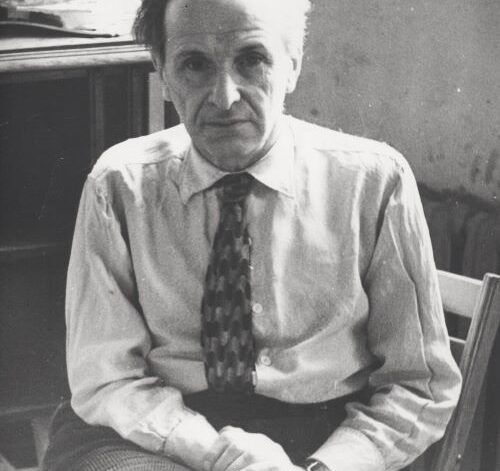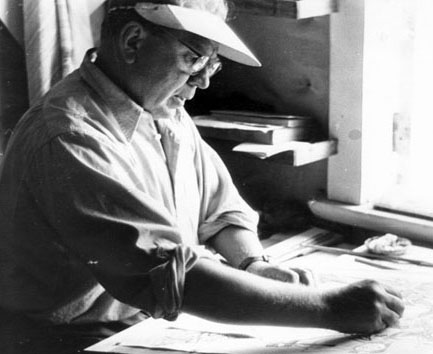
Evgeny Mikhailovich Rachev (1906–1997) was an artist and book illustrator.
He was born in Tomsk and spent his childhood in a village with his grandmother. In 1920, he traveled on his own to Novorossiysk to join his mother, worked in the port, studied at a maritime vocational school, and later at a locomotive technical college. From an early age, he was passionate about drawing and wrote poetry; his drive toward creativity led him to the Kuban Art and Pedagogical College in Krasnodar, which he graduated from with honors in 1928. After graduation, he studied for a time at the Kyiv Art Institute, and from 1930 began collaborating with various Kyiv children’s publishing houses as an illustrator. He joined a group of young avant-garde graphic artists associated with the Kyiv publishing house Kultura, among them L. Hamburger, B. Ermolenko, B. Kryukov, I. Kisel, and M. Boichuk. In 1936, Rachev’s drawings — by then increasingly focused on Russian fairy tales and fables — were noticed by Detgiz, and he was invited to move to Moscow.
In 1960, Rachev became chief artist of the children’s publishing house Malysh, a position he held for nearly twenty years.
Evgeny Rachev devoted more than sixty years of his creative life to children’s books. Numerous works were published with his illustrations, including The Storehouse of the Sun by Mikhail Prishvin, My Animals by Lev Durov, Alyonushka’s Tales by Dmitry Mamin-Sibiryak, Satirical Tales by Mikhail Saltykov-Shchedrin, Krylov’s fables, works by Vsevolod Garshin, Ivan Franko, Leo Tolstoy, Sergey Mikhalkov, Vitaly Bianki, as well as a vast number of folk tales — Russian, Ukrainian, Belarusian, Hungarian, Romanian, Tajik, and many others.
The younger the audience one works for — and therefore the less life experience they have — the greater the responsibility of the artist.
***I am an animalist — an artist who draws animals. But not the animals that live in the forest, rather those that inhabit fables and fairy tales. Fairy-tale animals speak, laugh, cry; their relationships are entirely human, and they live according to human laws.
***All my life I have preserved my love for all living things. To create illustrations for animal tales, one must, of course, know nature well. One must know what the animals and birds one intends to draw actually look like. You cannot even draw a sparrow until you have truly observed it.
I can draw a long-eared hare, a sharp-toothed wolf, or a raven. But after reading a fairy tale, I still do not rush to pick up my brushes and paints. Because in fairy tales, animals resemble different kinds of people: kind or cruel, clever or foolish, mischievous, cheerful, amusing.
That is why, before drawing, one must learn more about the people who lived in the places where the tales were created. Then I can clearly imagine my fairy-tale characters, as if they were old friends or acquaintances.
What interests me most is conveying the character of an animal in a drawing — good-natured or cruel, harmless or predatory. Studying an animal’s appearance and character, one unexpectedly notices that some animals or birds closely resemble certain people, and people, in turn, resemble animals or birds. And if I were to meet a bear dressed in clothes in the forest, I would probably not be surprised, but would respectfully say to the master of the forest:
‘Good day to you, Grandfather Bear!’
And if you look at my drawings and delight in the playful fairy-tale invention — then I have succeeded, as in a fairy tale.
If, looking at my birds and animals, you sense that the fairy tale has a hint, an allusion to people — then I have succeeded, as in the fairy tales I illustrate.
***It is not only the peacock that is beautiful — the sparrow is beautiful too. But its beauty is modest; one must know how to see it. Sometimes there is far more beauty in a small puddle than in a vast lake.
Website | evgenii-rachev.narod.ru
Amazon | Evgeny Rachev