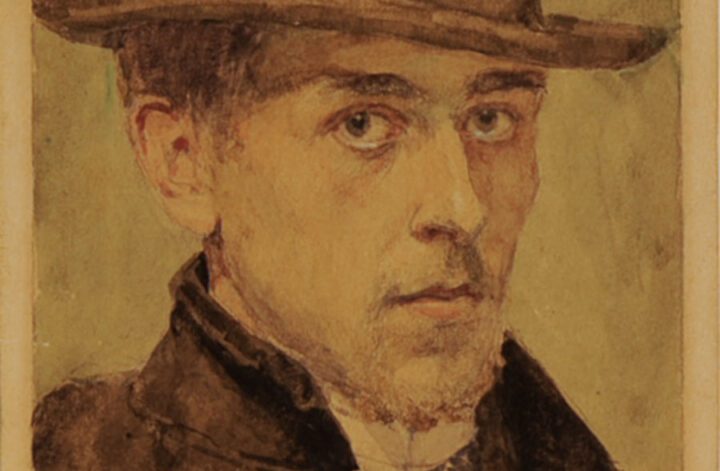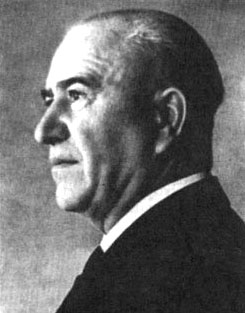
Aleksandr Deyneka (1899–1969) was a Russian painter, muralist, graphic artist, and teacher.
He was born in Kursk into the family of a railway worker. In 1917 he graduated from the Kharkiv Art School; afterwards he designed theatrical productions, propaganda trains, and worked as a photographer. From 1919 to 1920 he served in the Red Army, where he directed the art studio of the Kursk Political Administration and worked on the “ROSTA Windows” posters in Kursk. After the army he entered the printing department of the Moscow VKhUTEMAS, where his teachers included Vladimir Favorsky and Ignaty Nivinsky. He began exhibiting in 1924. In 1925 he became one of the founders of the Society of Easel Painters; after leaving it three years later, he joined the art group “October” and later the Russian Association of Proletarian Artists.
During World War II he created posters for the “TASS Windows” workshop and travelled to the front; in his easel painting he focused mainly on wartime subjects and motifs. Alongside graphic and painted works, he also created several monumental mosaics for the foyer of Moscow State University, the Palace of Congresses in the Moscow Kremlin, and the Mayakovskaya and Novokuznetskaya stations of the Moscow Metro.
Deyneka also taught extensively: at the Moscow VKhUTEIN (1928–1930), the Moscow Polygraphic Institute (1930–1934), the Surikov Moscow State Art Institute (1934–1946, 1957–1963), the Moscow Institute of Applied and Decorative Arts (1945–1953), and the Moscow Architectural Institute (1953–1957).
“Deyneka searched for the typical and avoided the individual. He depicted people while avoiding the person.
The collective seemed more important to him than the individual. Behind the beauty of the collective he failed to notice the beauty of personality.” — Abram Efros
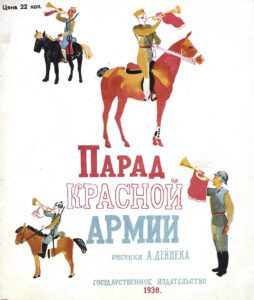
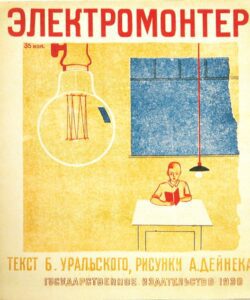
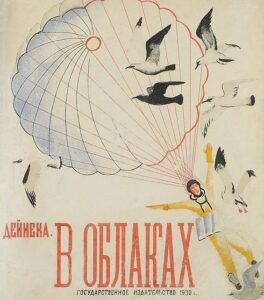
“Aleksandr Deyneka was a stern, sharp artist, seemingly far from ‘children’s’ art. Yet he created more than a dozen remarkable children’s books without betraying himself either in subject matter (labor, mass celebrations, aviation, the army), or in the poster-like stylization of color and composition, or often in the harshness of his graphic manner and dramatic intensity.” — Yuri Gerchuk
“I love a pure, resonant patch of color… Sometimes form is captivating through color… Sometimes a living form is captivating through its power, through the inner conviction of its beautiful essence. Form is beautiful through its coloring and its proportions…”
“I understand painting, subtle painting, but I love drawing and form even more. If some people can distinguish the finest tonal nuances while remaining completely indifferent to грубым distortions of form, then with me it is the opposite — I am extremely sensitive to the subtlest rhythms of form and am satisfied with simple color relationships…”
“For hours I fill album pages with these clumsy, schoolboyish yet dynamically truthful ‘sniper-like’ sketches of Dynamo divers. Every minute a person flies through the air. An instant — the eye catches the effect of flight. Another instant — and while the diver’s head emerges from the water, I quickly draw the impression onto the page. And I rejoice and think of how it will lie organized on the Whatman paper, how it will spread into umbers of mountains and the turquoise of a cruiser beneath the flying figure.”
“From my youth I was drawn to healthy work and people’s leisure. I always wanted to remember and sketch all of it.”
“New machines have appeared, houses are built differently now. The time has come for us to reconsider our understanding of beauty, which in many cases has become outdated… Many artists still think that a battered, half-ruined hut is picturesque and beautiful, while a new, well-equipped settlement is not picturesque… Beauty is closely connected to our present day. We often forget that people themselves have changed as well.”
“On the turn of an automobile I see the street rush sideways, tilt at a sharp angle. From the window of a moving train I see how enormous the field is and how small the person within it, and how monumental a person appears against that same window with green trees, red buildings, and endless power lines streaking past behind him. From the bank of an airplane I see the earth hanging before me like a relief map. People still habitually perceive top and bottom as sky and earth, yet a loop-the-loop literally turns everything upside down; in your painting the lower part may become cobalt sky while the upper is loaded with pink mountain masses… and the dull horizon that usually cuts the picture in half suddenly becomes an unexpected diagonal in flight. Far below, another airplane moves like a dark fly across the glass — pictorial composition demands corrections and new chapters in the study of aerial perspective.”